Tarro
Making restaurant delivery easier to dispatch, execute, and track
I redesigned Tarro’s self-delivery experience across the POS, CMA, and a new driver-facing mobile app, giving restaurants a more complete system for managing deliveries from dispatch through drop-off.
Summary
Problem
Managing self-delivery was highly manual and fragmented across tools. During a rush, staff had to batch orders, assign drivers, and track runs, while drivers called the restaurant for help.
What I did
Redesigned self-delivery as one connected system: dispatching in the POS and CMA, and a new driver app for completing deliveries independently.
Outcome
Validated in live restaurants. Driver Management V2 established a foundation for restaurants to manage self-delivery directly within Tarro, connecting staff and driver tools into one end-to-end workflow.
The opportunity
Delivery is an important revenue channel for many of Tarro’s restaurant clients. Pizza shops can generate 20–35% of revenue through delivery, often relying on stacked weekend runs. Chinese-American takeout restaurants may deliver across a 5–8 mile radius, with a significant share of orders paid in cash and deliveries handled by family members or long-tenured employees.
But managing those deliveries can be highly manual.
During a rush, staff need to quickly decide which orders to send together, assign the right driver, track active deliveries, and answer customers asking where their order is. Drivers, meanwhile, need to know what to pick up, where to go, and what to do when they arrive without constantly calling the restaurant for help.
The opportunity was to bring the entire self-delivery workflow into Tarro.
Two ways Tarro supports delivery
Tarro supports restaurants with both self-delivery and Tarro Delivery.
Self-delivery
Restaurants use their own drivers, with Tarro providing the tools to manage orders, dispatch drivers, and track deliveries.
Tarro Delivery
For restaurants that don’t have enough drivers, Tarro can provide delivery coverage through our delivery network. Tarro uses FIRST Delivery, which aggregates third-party delivery providers such as Uber, DoorDash, and Relay.
My focus was on improving the self-delivery experience and giving restaurants the tools to operate their own delivery business more effectively.
The challenge
The existing experience was fragmented across different tools and required too much manual coordination.
Staff needed to answer questions like:
- Which orders should be grouped into the same run?
- Which driver should take them?
- Where is each driver right now?
- When will they be back?
- Has an order been delivered?
- What should the driver do if they can’t reach the customer?
The goal wasn’t simply to give drivers a mobile app. It was to create a connected delivery system where each person gets the information and controls they need at the right moment.
A connected delivery system
Driver Management V2 introduced three connected surfaces.
POS
For dispatching, batching orders, assigning drivers, and monitoring active runs.
CMA
For accessing delivery management from a lightweight, client-facing device without requiring the full POS setup.
Driver app
For drivers to manage their run, access order details, navigate to customers, communicate when needed, and complete deliveries independently.
Together, these surfaces support the full workflow
- Order
- Dispatch
- Delivery
- Completion
Design goals
Run delivery end-to-end in Tarro
Give restaurant staff one place to batch orders, assign drivers, monitor active deliveries, and understand the state of every run.
Make rush dispatching fast
Help staff identify nearby orders, create efficient runs, assign drivers in seconds, and quickly understand who is out delivering and when they’ll return.
Help drivers deliver without store assistance
Give drivers the information they need at each step of the delivery, reducing forgotten items, failed drop-offs, and unnecessary calls back to the restaurant.
Designing the driver experience
The driver app was intentionally designed as a focused workspace rather than a mobile version of the POS.
Drivers typically interact with the app while moving between tasks, so the experience prioritizes clear hierarchy, minimal decisions, and actionable information.
I designed the driver-facing app from the ground up, including order assignment and live tracking, and validated it in live restaurants.
The core flow
- Start run
- Grab orders
- Navigate
- Contact customer
- Complete delivery
At each stage, the app surfaces the information needed to complete the next action without overwhelming the driver with everything happening across the restaurant.
Dispatching a rush
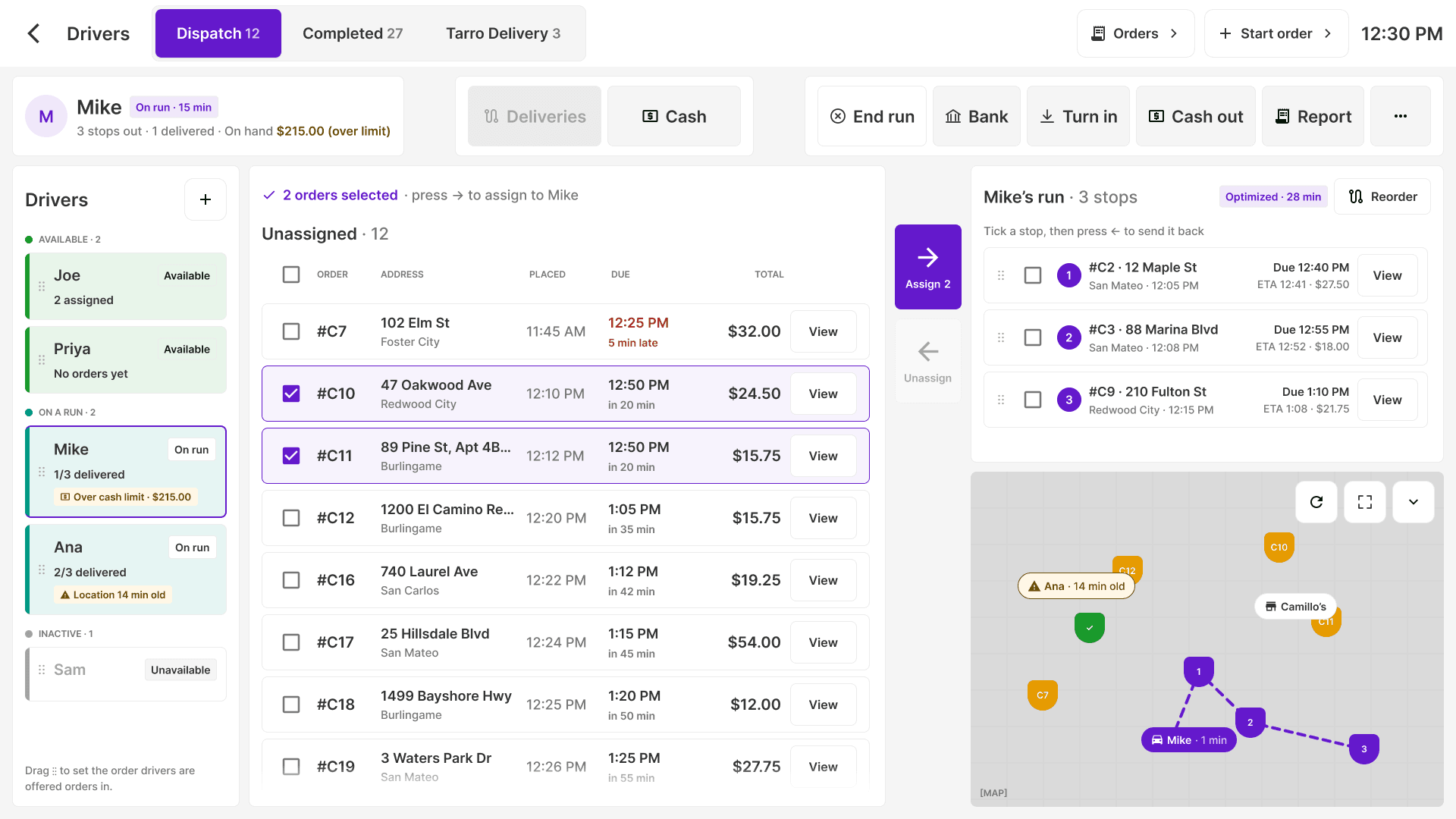
On the restaurant side, the goal was to make dispatching feel more like managing a live operation than processing individual orders.
Staff can see unassigned orders alongside active drivers, identify orders that can be grouped together, and assign them to a driver as a single run.
The map provides spatial context, while the driver queue provides operational context: who’s available, who’s out delivering, and who’s returning.
This lets staff answer the question that comes up constantly during delivery, without needing to call or search through another system:
“Where’s my driver?”
Designing for real restaurant constraints
The experience needed to work for very different delivery operations.
Some restaurants have a dedicated team of drivers. Others rely on a few employees who switch between restaurant and delivery duties. Some primarily take card payments, while others have a high volume of cash orders.
Rather than assuming one ideal delivery operation, I focused on creating flexible workflows that could support different staffing models while keeping the core interactions consistent.
The design also needed to work in the high-pressure environment of a restaurant: fast-moving orders, frequent interruptions, limited attention, and staff who may not have time to learn a complicated new system.
Outcome
Driver Management V2 established a foundation for restaurants to manage self-delivery directly within Tarro, connecting the tools used by staff and drivers into one end-to-end workflow.
The broader goal is simple:
More deliveries, fewer operational headaches, and less time spent figuring out where an order or driver is.